
By Barry Venable
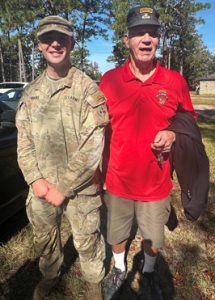
Seated in the bleachers at Victory Pond in Fort Benning, Georgia, on October 30th, my wife Kim and I awaited our son Joshua’s graduation from the U.S. Army’s Ranger School. Before the ceremony started, we watched an older gentleman in a black hat leave the VIP section. He strolled over to where the soon-to-be graduates were gathered. The man spent a few minutes talking to the group, and he clearly held their close attention. After saying goodbye, he returned to the VIP section, where senior officials greeted him warmly.
I turned to my wife and asked, “I wonder who that guy is.”
Our conversation had to wait, though. The ceremony was starting. Our attention shifted to the thrill of watching our son graduate and receive the Ranger tab. After the crowd filtered away, we stood by our car taking a few last photographs when the man in the black hat stopped by to shake our son’s hand.
“Where are you from, son?” the man asked.
“Minnesota, Sergeant Major,” Joshua replied.
“So am I,” the man said. Joshua asked, “What town?”
“Oh, a little place you probably haven’t heard of called Cold Spring,” the man said.
Joshua laughed. “Well, I’m from Richmond, Sergeant Major.”
“ROCORI High School, class of 1970,” the man said.
Joshua replied, “Class of 2021.”
With that chance introduction, we enjoyed a delightful conversation with an American hero from the Cold Spring area. Retired Command Sgt. Maj. Gerald “Gerry” Klein had a legendary 35-year military career. His service was heavily rooted in the elite Ranger community before he moved into high-level leadership positions for the broader U.S. Army Infantry.
Klein was inducted into the Ranger Hall of Fame in 2012 for his immense impact on the Ranger community. He is also the recipient of the 2025 Doughboy Award, the Infantry branch’s highest honor. For over 30 years he was one of those dedicated soldiers accomplishing the toughest missions while the rest of us slept safely in our beds. His leadership roles included serving as a squad leader, platoon sergeant, and first sergeant within the 75th Ranger Regiment.
As a platoon sergeant in 1983, he deployed to Grenada with the 2nd Ranger Battalion during Operation Urgent Fury. He earned the Army Commendation Medal with a “V” device for valorous actions. He later became the command sergeant major for the 3rd Ranger Battalion in Panama. There, he executed his second combat jump during Operation Just Cause in 1989. Klein went on to serve as the top enlisted leader for the Joint Readiness Training Center Operations Group at Fort Polk, Louisiana, training units for complex combat deployments. He finished his career as the Infantry School’s top enlisted leader at Fort Moore from 1994 to 1997.
In his retirement, Klein remains heavily involved with the military. He regularly presents leadership awards on behalf of the National Ranger Memorial Foundation to new Ranger School graduates. This role is what brought Klein to Victory Pond. He took time to congratulate Joshua on his achievement and remind him of his obligations as a Ranger-qualified leader.
The U.S. Army Ranger School has served as the Army’s combat leadership crucible for more than 75 years. It develops the functional skills and mental toughness required of platoon and squad leaders in close combat. The course lasts 62 days and retains its brutal challenges across three distinct phases.
The first phase, conducted at Fort Benning, weeds out those who are physically or mentally unprepared. It begins with Ranger Assessment Phase, or RAP Week. This is a brutal four-day physical gate that includes a fitness assessment, combat water survival, land navigation, and a timed 12-mile foot march under a heavy pack. Students who survive RAP week move to Camp Darby to learn the fundamentals of squad-level combat operations, patrolling, and reconnaissance.
The second phase, held at Camp Frank D. Merrill near Dahlonega, Georgia, shifts the focus to military mountaineering and platoon-level operations. Students receive intensive instruction on knots, belays, rappelling, and rock climbing. They must then plan and execute non-stop combat patrols across steep, rugged terrain while severely sleep-deprived and calorie-restricted. Many graduates consider this the most physically punishing phase due to the heavy loads and extreme elevation changes.
The final phase, held at Camp James E. Rudder at Eglin Air Force Base, Florida, tests highly stressed students in coastal swamps and jungle environments. Training emphasizes waterborne operations, including small boat movements, stream crossings, and rope bridge construction. Students must lead fast-paced platoon tactics against a constant opposition force under maximum mental and physical exhaustion before finally earning the prestigious Ranger Tab.
It was an honor and a privilege to speak with Klein and to enjoy some hometown and school pride with him.
Second Lt. Joshua Venable graduated from ROCORI High School in 2021 and received his active-duty commission through the ROTC program at South Dakota State University in 2025. He recently completed the Infantry Basic Officer Leader Course and Ranger School. He will soon report to his first duty assignment with the 4th Infantry Division at Fort Carson, Colorado.